
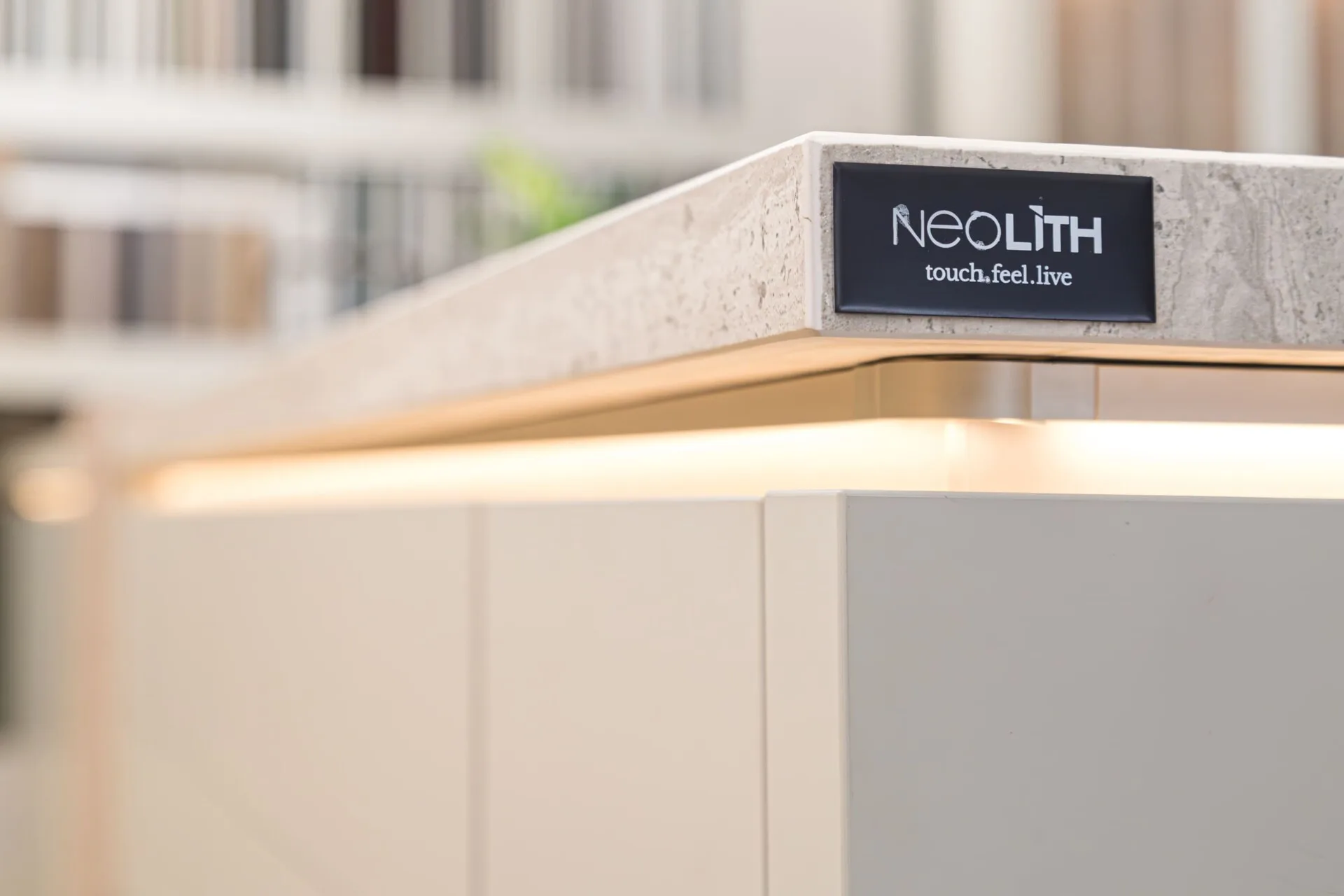
The Neolith, it's a product manufactured from natural raw materials such as minerals, clays, feldspar, silica and natural oxides.
It is produced by the sintering technology (technology that uses a laser to join layers of various materials and transform them into a single piece), which subjects the materials to high pressures and extreme temperatures (over 1200 ºC). This causes the components to fuse, creating an ultracompact, strong, and durable material.

Neolith has gained popularity for countertop installation compared to other materials for the following reasons:
Although Neolith is a highly valued material for kitchen countertops, it also has some disadvantages that are important to consider before deciding to install it:
| Material | Neolith | Granite | Marble | Quartz |
|---|---|---|---|---|
| Heat resistance | Very high | High | Average | Average |
| Stain resistance | Very high (waterproof) | Media (requires sealing) | Low | High |
| Maintenance | Very low | Half | High | Low |
| Aesthetic variety | Wide (natural imitation) | Limited natural resources | Limited natural resources | Wide |
| Porosity | Zero | Porous | Porous | Almost none |
At Cocinas Plus, our assessment of Neolith as a porcelain material for countertops is clear: it is a A premium option that combines technological innovation, aesthetics, and functionality, ideal for those seeking a balance between durability and contemporary design.
Neolith stands out for its extreme resistance to heat, scratches, and stains, as well as its unparalleled hygiene thanks to its zero porosity. Its wide range of finishes allows it to mimic natural materials such as marble, granite, or wood, offering a sophisticated look with minimal maintenance. These qualities make it a long-term investmentespecially in high-traffic kitchens where durability and cleanliness are priorities.
However, it is not a material without its challenges. The high initial cost and the complexity of its installation require a careful planning and the intervention of experienced professionalsFurthermore, its repair can be complicated if it is damaged.
Therefore, I would recommend Neolith to customers who value quality, durability, and aesthetics Above all, they must be willing to make a higher initial investment. It's an ideal material for modern, minimalist, and functional projects where the goal is to create an elegant and virtually indestructible countertop, ensuring a long-lasting result with minimal maintenance.


