
To design a custom kitchen, we need to understand a series of concepts and references that will help us plan the layout of the furniture in relation to the individual needs.
To design a kitchen, we first need to know the measurements of the roomOnce we have these measurements, we could begin to plan the design, taking into account the client's needs and ideas.

To create a correct design for any of these types of kitchens, we must take into account a series of rules so that the proportions be appropriate with respect to the size of the room.
In a kitchen, there are three key areas, known as the work triangleThese areas differ from each other in the specific functions performed in each one:
To ensure the kitchen is well-proportioned and easy to work in, it is recommended to create a triangle between the three areaswhere each vertex of the triangle leads to a work area. Furthermore, it is recommended that each side of the triangle measure between 120 and 270 cmTherefore, the sum of its sides must lie between 400 and 790 cmTo have freedom of movement, it is important that there are no obstacles within the perimeter of the triangle.
In the case of having facing furniture or a kitchen on two sides, there must be a minimum distance between both fronts of 120 cmKeep in mind that a person transporting any type of household goods needs between 80 and 100 cm wide so you can do it comfortably.
If the triangle rule cannot be followed because the kitchen has only one wall, there must be free countertop spaces between the cooking, washing and storage area.
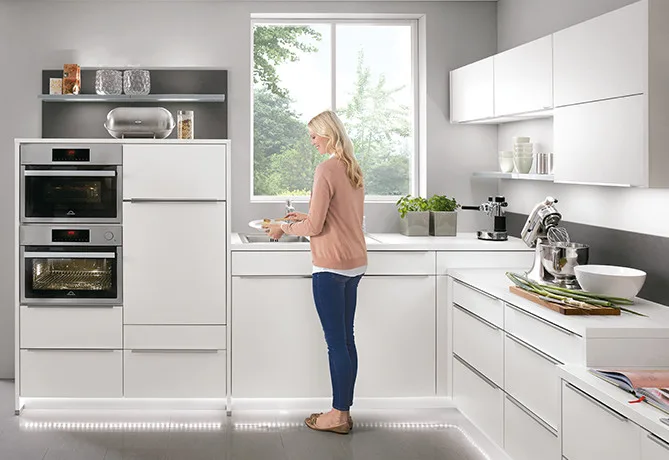
It is recommended to leave a space of about 50 cm on each side of the ceramic hob or cooking and cooking area 60 cm if the washing area It is close to the cooking area.
Once we have detailed the aspects that apply specifically to each type of kitchen, let's continue with the generic measures applied to all kitchens as a whole, regardless of the type.
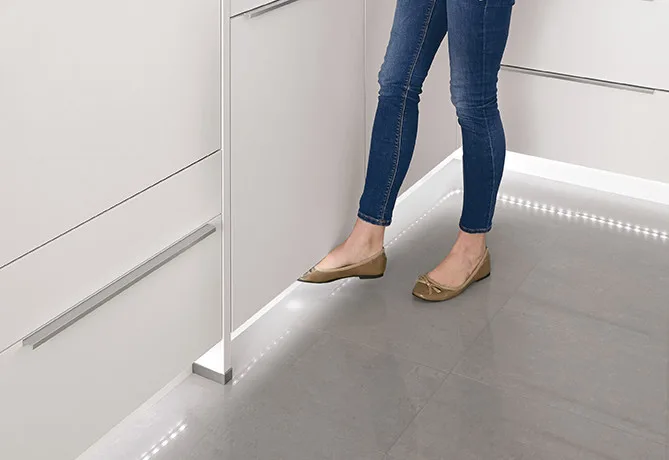
The height of lower baseboard It should be between 7 and 15 cm.
The worktop It usually has a height of between 0.8 and 2 cm.
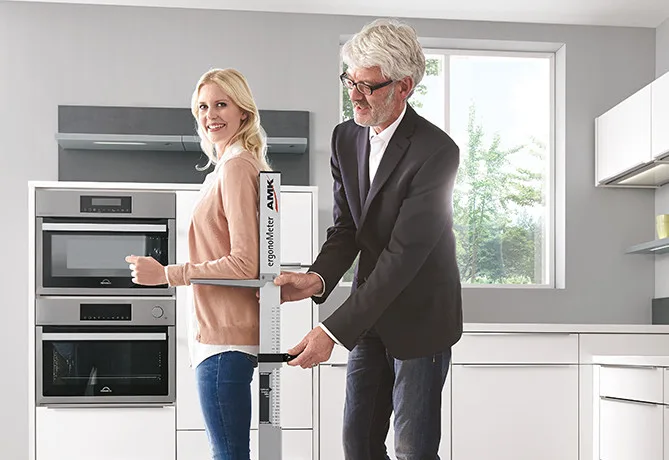
The height of kitchen cabinets will depend on the height of the person who will be using them. Generally, countertops are placed at a height between 90 and 100 cm.
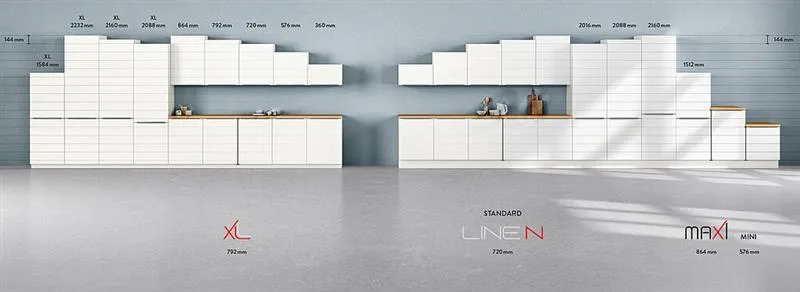
The bottom of the base cabinets and kitchen columns is usually in 60 cmHowever, the depth of the tall cabinets will comprise between 30 and 40 cm with a length of between 70 and 90 cm high, located 1.5 m from the floor and between 60 and 50 cm from the countertop.
In small kitchens, it is not recommended that the cabinet doors have a width greater than 40 cm to avoid obstructing the passage.
The vast majority of household appliances have a 60 cm deepHowever, there are refrigerator models that can reach depths of up to 90 and 100 cm.
The oven It should always be less than 80 cm from the ground to avoid discomfort when working, but it should be high enough to prevent children from using it.
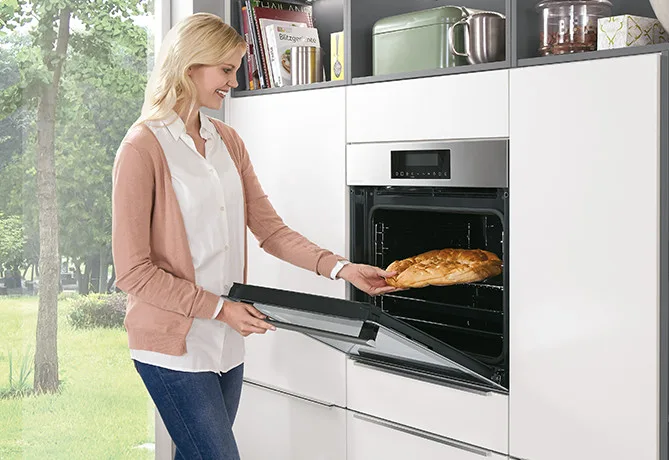
The dishwasher It should be as close to the sink as possible and should be left between 100 and 120 cm to facilitate its opening and not interrupt the passage.
When installing the extractor hoodYou should follow the manufacturer's instructions, but it is usually located about 60 cm of the ceramic hob.
It is recommended to install a lighting system with zonal contrast under the tall furniture, since this way we can avoid the presence of shadows created by the ceiling light.
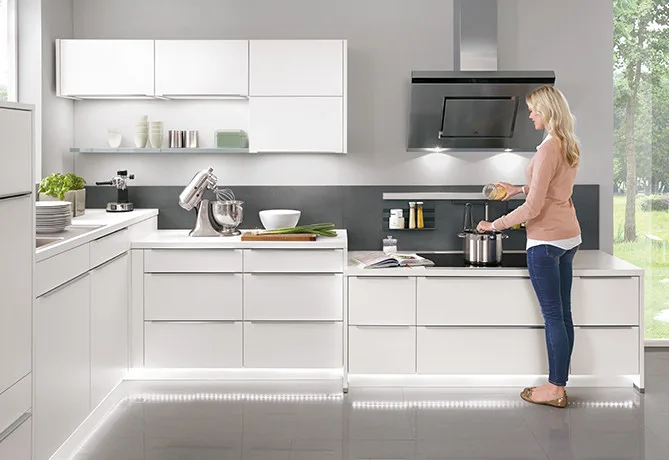
It is recommended to place the household items in a drawer near the cooking area.
It is not recommended to place drawers in cornersIt is always better to install hinged doors or storage spaces that adapt to the available space.
Do not place a dishwasher or oven perpendicular to a wall, as access and maneuverability would be difficult.


