With the advancement of technology in household appliances, we have gained a lot in energy efficiencyleaving behind gas stoves and gradually replacing them with ceramic and induction hobs.
Ceramic and induction hobs are two types of systems that represent significant technological advancements in the sector. Both types of hobs coexist in the market and both are successful and functional for people when working in the kitchen.
In today's article, we explain the differences between induction hobs and ceramic hobs.
In Cocinas Plus We specialize in custom kitchens. Contact us now for more information.
What is an induction cooktop?
The induction hob It's a cooktop, it's a type of electric cooking surface that uses electromagnetic fields to generate heat directly in the cooking containers instead of heating the surface of the hob.

How an induction hob works
- Generation of the electromagnetic field: Beneath the surface of the cooktop, usually made of tempered glass or ceramic, are copper coils. When the cooktop is switched on, an alternating electric current passes through the coils, generating a changing magnetic field.
- Induction in the container: When a ferromagnetic container (made of iron or suitable stainless steel) is placed on the plate, the magnetic field induces electric currents called Foucault's currents at the base of the container. These currents circulate through the metal of the container, causing electrical resistance that generates heat.
- Direct heating of the container: The heat is generated directly at the base of the pan, without needing to heat the surface of the hob. This allows the energy to be concentrated where it is needed, improving the efficiency and reducing heat loss. The surface of the plate barely heats up, except for the residual heat transmitted by the pan after it has heated up.
- Temperature and power control: The technology allows for precise and rapid temperature control, since by adjusting the electric current in the coils, the intensity of the magnetic field is modified and, therefore, the amount of heat generated.
Advantages of induction hobs
- Energy efficiency: They heat up quickly and lose less energy because they do not heat the surrounding air.
- Security: The surface does not get too hot, reducing the risk of burns.
- Precise temperature control: They allow for quick and precise temperature adjustments.
- Easy to clean: The flat, cool surface prevents food from sticking and makes cleaning easier.
- Speed: They can boil water or cook food faster than other systems such as gas or ceramic hobs.
What is a kitchen with a ceramic hob?
A kitchen with ceramic hob It is a type of electric cooking surface that uses electrical resistors located under a ceramic glass surface to generate heat. This heat is transmitted from the hob to the cookware and, therefore, to the food.
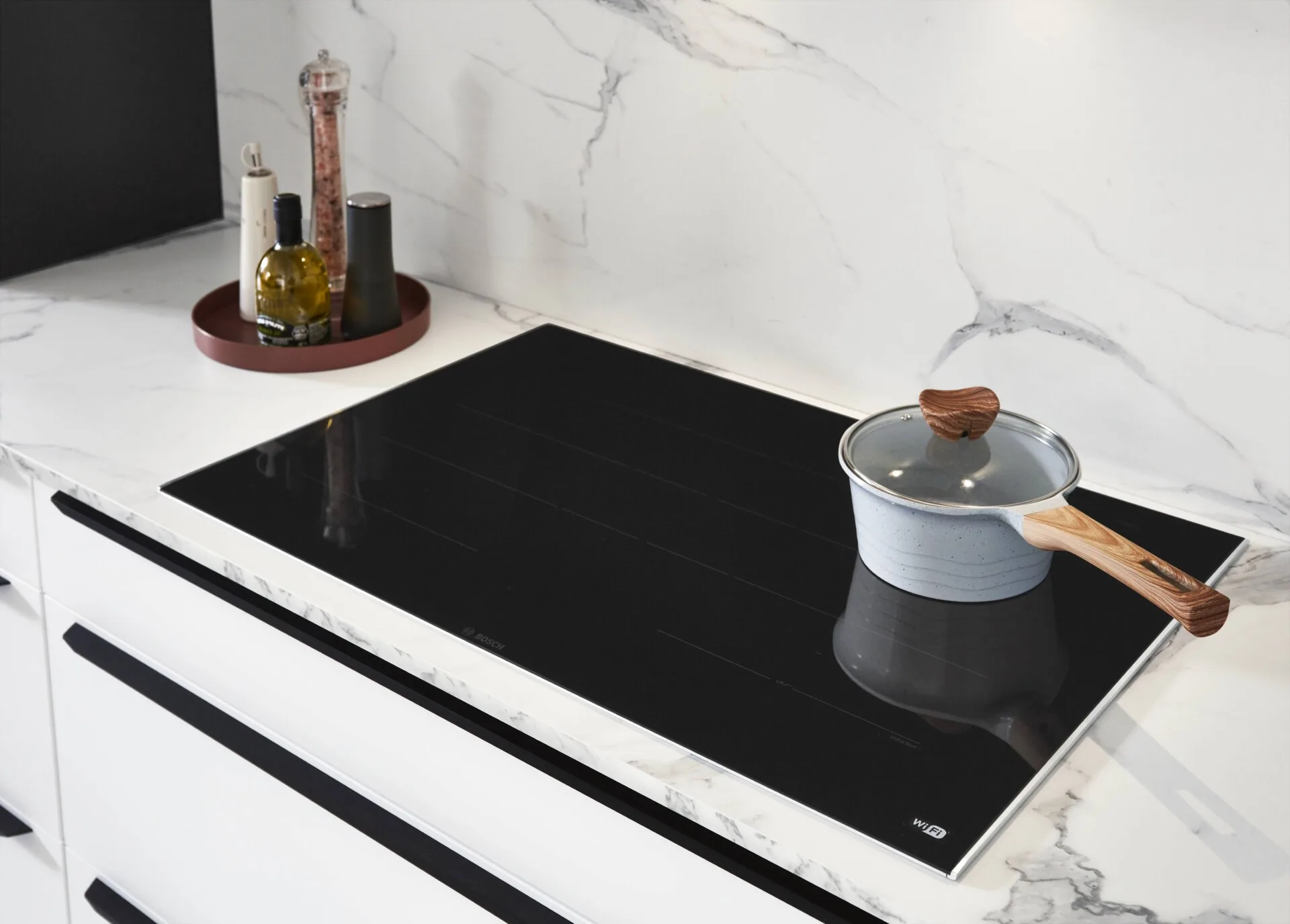
How a ceramic hob works
- Electrical resistors: Beneath the ceramic glass surface are electrical resistors or radiant elements. When the cooktop is switched on, the resistors generate heat as an electric current passes through them.
- Heat transmission: The heat generated by the heating elements is transmitted upwards, heating the ceramic glass surface. From the heated surface, the heat is transferred to the containers and then to the food.
- Ceramic glass surface: Ceramic glass is a material resistant to heat and sudden temperature changes. Furthermore, its surface is flat and easy to clean.
- Temperature control: Power and temperature are regulated by electronic controls, allowing cooking at different heat levels. However, the response to temperature changes is slower compared to induction.
Advantages of ceramic hobs
- Easy to clean: Its flat surface makes it easy to clean up spills.
- It can be used with any material: It does not require special containers.
- Modern aesthetics: It has an elegant and minimalist design.
What are the differences between an induction cooktop and a ceramic hob?
Both plates, induction and vitroceramicThey all share a ceramic glass surface that provides an elegant appearance and facilitates cleaning. However, their operationEfficiency and characteristics present clear differences:
- Operation: Induction hobs use electromagnetic fields generated by copper coils located beneath the surface. These electromagnetic fields induce electrical currents in the base of the cookware, generating heat directly in the cookware, not the hob. Ceramic hobs, on the other hand, work with electric heating elements or radiant panels beneath the ceramic glass surface. These heating elements heat the surface of the hob, which in turn transfers the heat to the cookware placed on top.
- Speed and energy efficiency: Induction hobs heat cookware faster because the heat is generated directly at the base of the cookware, and they are more energy efficient (approximately 85-90%) because there is minimal heat loss to the surrounding environment. Ceramic hobs are slower because they first need to heat the ceramic glass surface before transferring the heat to the cookware. Their energy efficiency is lower (around 60-70%) due to heat loss to the environment and the time it takes to heat up and cool down.
- Temperature control: Induction hobs offer much more precise temperature control, as they allow for almost instantaneous power adjustments. However, ceramic hobs offer slower temperature control, both when increasing and decreasing the heat, due to thermal inertia.


